
Acceptance, Purposeful Development and the Configuration Gap
In recent days, the same advert has kept appearing in my social media feed. A senior woman begins a new role and tries to introduce herself in her first meeting. English is her second language, and she has a noticeable accent. Before she can finish, someone interrupts her. Later, she is excluded in the coffee room.
The video captures a feeling many of us have known at least once: being left outside the group and wondering whether we belong. The advert then connects that feeling to a development programme. The implication is clear: no matter how experienced you are, if you cannot speak like them, you will feel ashamed, alone and unsuccessful.
Fifteen years ago, I would have bought that programme. In fact, I did. I believe that, before coaching, mentoring or advising others, I should first develop myself in the areas in which I intend to support them.
I have been different all my life. Sometimes deeply analytical, sometimes deeply emotional; sometimes introverted, sometimes extroverted; sometimes absorbed in detail, sometimes strategic; sometimes profoundly local, sometimes profoundly global. Over time, I understood that these were not inconsistencies. They were the polarities of being human. Leadership presence is not about looking the same in every room. It is about not becoming estranged from yourself, whichever side comes forward.
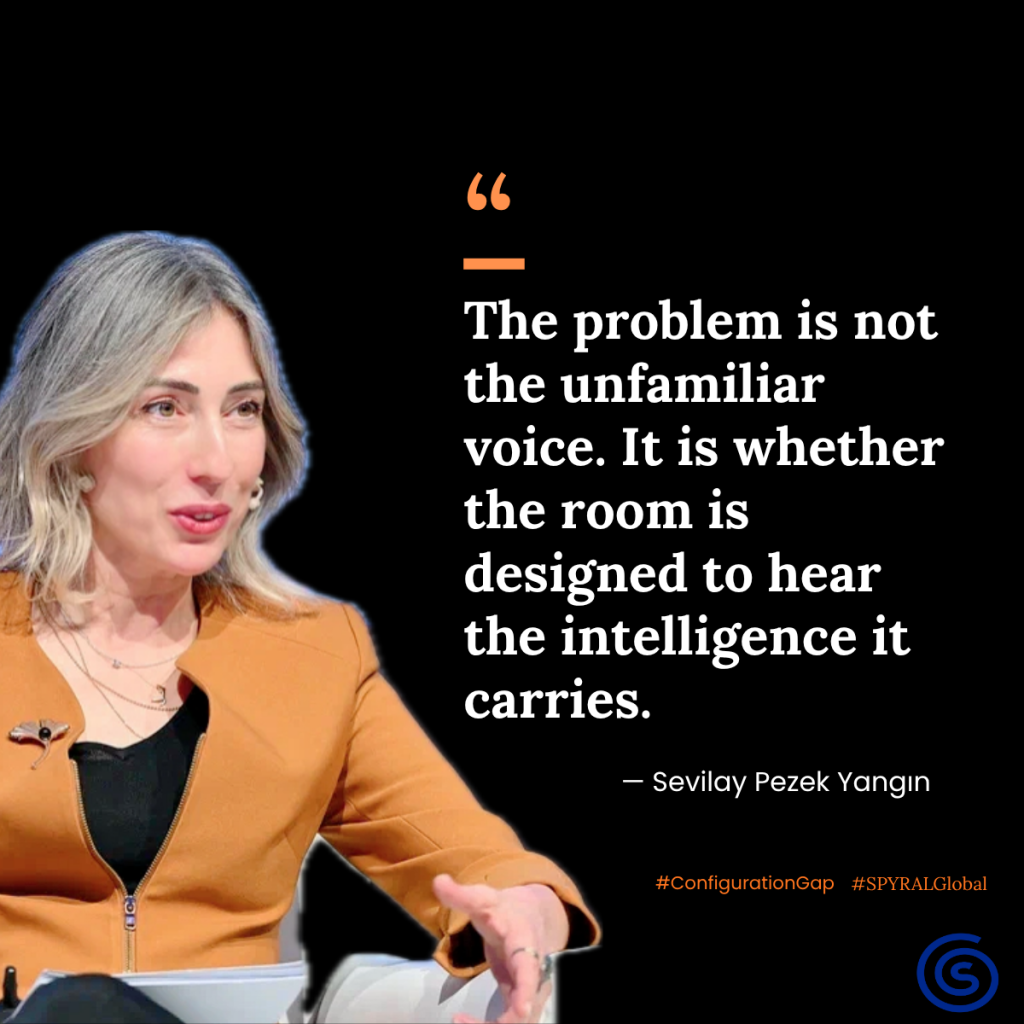
Today, I ask a different question first: Is the problem really the person’s capability, or the room’s capacity to hear intelligence when it arrives in an unfamiliar voice?
Sometimes the issue really is a capability gap. Sometimes it is the environment. The most expensive mistake is to confuse the two. While searching only for the fault within yourself, you may realise too late that the system rewards incuriosity and sameness. At that point, what you need is not more training. It is an accurate diagnosis.
An accent is not a capability gap
Working as a global leader across cultures and living in Dubai taught me how differently—and often unfairly—accents can be perceived. Some accents are treated as signs of prestige. Others are treated as credibility problems, regardless of the expertise behind them. These reactions are often less about communication skill than about familiarity, status and the assumptions we quietly attach to identity.
It is entirely natural for someone speaking in a second or third language to have an accent. An accent, in itself, tells us nothing about their intelligence, judgement or leadership capacity. Usually, it simply means that they are communicating in a language other than the one in which they first learned to think, debate and dream.
Leadership presence should not mean learning to resemble the people an organisational culture already accepts. A leader may pause because they are thinking in two languages. They may remain quiet on their first day because they are reading the room before entering it. Neither is inherently a communication failure.
The question is not only whether the person can express themselves. We must also ask whether the team and culture have the capacity—and have built the systems—to receive communication and intelligence that do not arrive in familiar forms.
Purposeful development begins with acceptance
I am not against learning English or developing communication skills. Despite years in multinational environments, I still work on how I communicate in both Turkish and English. That desire does not come from inadequacy. It comes from my wish to contribute more fully and my commitment to learning. My goal is not to hide my accent or become perfect. Out of respect for the listener, I want to reduce the cognitive load I place on them.
There is a real difference between expanding someone’s capacity and teaching them to hide what is natural in them. Acceptance does not mean ignoring our standards. It means consciously refusing to make sameness the price of belonging.
Behaviour that does not come from within is like borrowed clothing. Even when it fits, it does not carry the person wearing it. Development becomes meaningful when it begins not in shame, but in a place that elevates the human being.
From a capability gap to the Configuration Gap
When a capable person cannot contribute because they are interrupted, disregarded or misread, we should not evaluate the situation only as an individual capability gap. Sometimes there may be no capability gap at all.
This is one expression of what I call the Configuration Gap.
At its broadest, the Configuration Gap is the distance between what an organisation can know, what people can safely say, what leaders can clearly decide and what the system can actually move. In this context, it appears as a misalignment between the intelligence already present and the culture and structures that allow it to become contribution.
It often becomes visible through beliefs, norms and arrangements that sit beyond the person’s direct reach or influence.
Who is allowed to finish a sentence? Whose pause is read as thoughtfulness and whose as inadequacy? Which behaviours are quietly coded as “leadership presence”? Whose idea is heard only after someone more familiar or more senior repeats it?
When the flaw is in the room, coaching the excluded person is a misdiagnosis disguised as development.
Redesign can begin with very practical choices: sharing questions in advance, offering written ways to contribute, protecting everyone’s right to speak without interruption, and noticing whose ideas gain value depending on who voices them. Representation matters, but identity alone does not guarantee inclusive leadership. Representation tells us who entered the room; behaviour tells us whether their intelligence can move within it.
What is knowledge worth if it is not relational?
A development programme can help a leader choose their words. It cannot, by itself, make others listen. Access alone does not create collective intelligence. A team may possess all the knowledge it needs, yet if no one feels safe enough to say what they see, that knowledge will not become movement.
Knowledge becomes collectively useful only when it can move through a relational system. That requires acceptance, trust, the emotional capacity to remain present in the discomfort created by difference, and the willingness to redesign the system.
This is why leadership is not only about supporting people’s development. It is also about building systems and cultures in which intelligence can be heard before it sounds familiar.
Let people remain human
There is nothing wrong with being quiet on your first day. Nor with being introverted, pausing, searching for the right word, or making a mistake in your first language or your fifth. If a team uses these human moments to diminish someone, the problem is not that person’s leadership presence. The problem is the team’s capacity to listen.
I do not give the leaders I work with a new identity. I create a space in which leaders can hear themselves more clearly. I hold up a mirror and, when useful, design experiences through which learning can happen. They do not work with me because something is missing in them. They work with me to direct their distinctive contribution more consciously and grow into a fuller version of themselves.
The leaders who shape what comes next will not simply be the strongest, the smartest or the quickest to adapt. They will be those who can read the system and turn intelligence into the right movement, without losing their presence, purpose or humanity.
The work is not merely to adapt. It is to remain calm enough to see what you are adapting to, and clear enough to choose what you need to transform.