
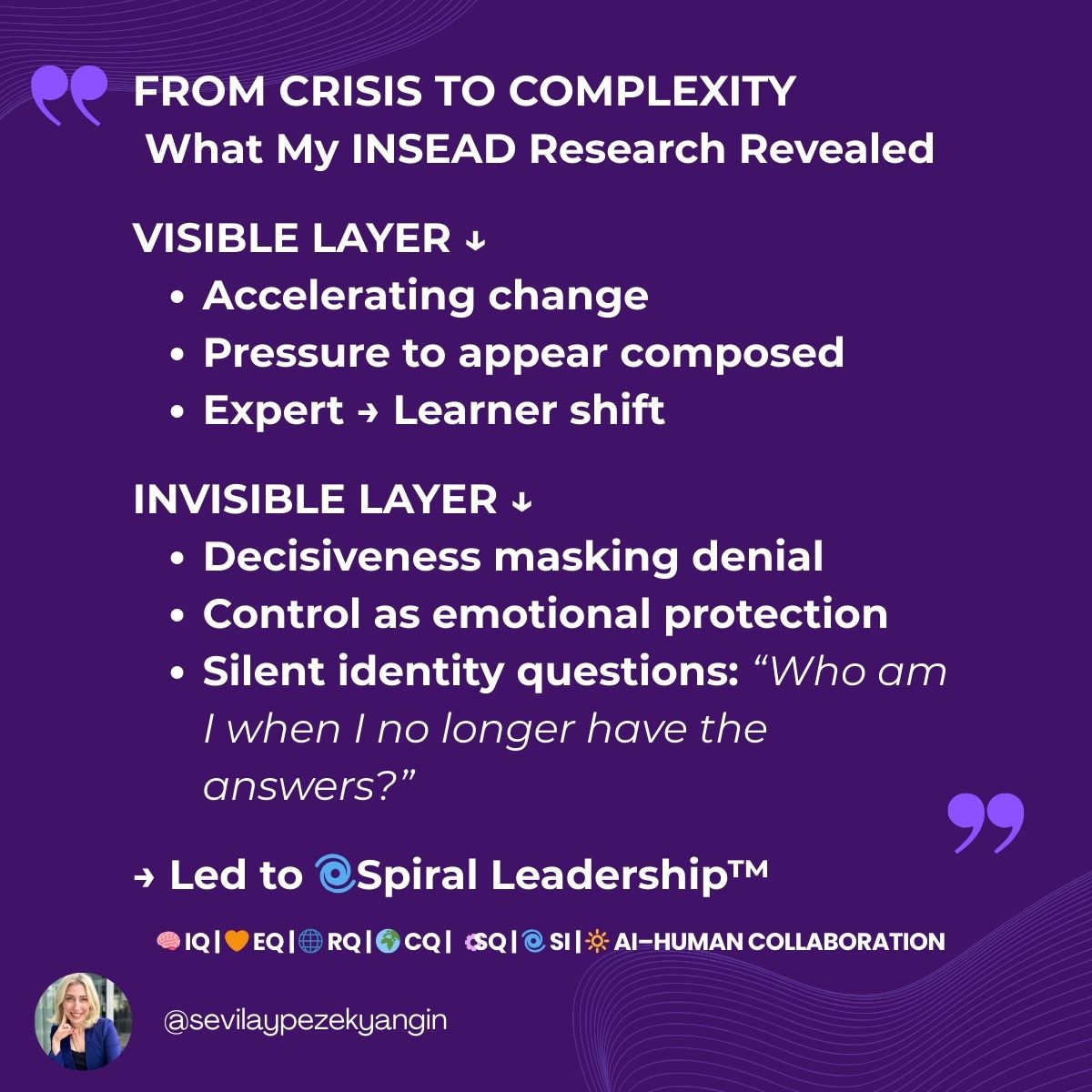
From Crisis to Complexity
In 2020, during my Executive Master in Change research at INSEAD, I interviewed a senior executive navigating the early uncertainty of COVID-19. He paused, his shoulders fell, and said quietly:
“I was the one having answers to all questions.
Now, each day I wake up with an unfamiliar sense of doubt, trying to manage never-ending uncertainties.”
He was one of the top talents, and he was not failing.
He was naming something leaders rarely say out loud:
The collapse of the expert identity.
Years later, I see this moment as the foundation for understanding not only crisis leadership but the deeper transformation required to lead in an era of permanent complexity.
The Disruption of Expertise
During the crisis, expertise lost its protective power almost overnight.
Leaders were expected to answer questions no one yet understood.
Mastery — once a source of certainty — suddenly felt insufficient.
Beneath the operational chaos was a psychological rupture:
The identity built on knowing was no longer enough.
Destabilizing, but also the opening to a more conscious leadership stance.
A Dual-Lens Discovery
My research used:
• Interpretative Phenomenological Analysis (IPA)
• A psychodynamic lens revealing unconscious role dynamics
These surfaced two parallel realities:
Visible Layer
• Accelerating change
• Pressure to remain composed
• The forced shift from Expert → Learner
Invisible Layer
• Decisiveness masking denial
• “Control” used to regulate inner anxiety
• Silent fears around identity and worth
• “Who am I when I no longer have the answers?”
These deeper dynamics helped differentiate leaders who merely survived from those who transformed.
What Effective Leaders Actually Did Differently
The leaders who adapted best did not tighten control.
They placed the human experience at the center.
Inner Work
• Allowed themselves to be vulnerable
• Managed ego consciously
• Chose curiosity over defensiveness
Relational Capacity
• Opened emotional space
• Built psychological safety
Systemic Stance
• Contained the system rather than controlling it
• Embraced “good enough” as wisdom
Winnicott’s “good enough mother” revealed a leadership truth:
Leadership is less about giving answers and more about creating the conditions where others find their own.
These insights shaped my article:
“Good Enough Is the New Perfect” (EAPM, 2021). https://eapm.org/navigating-through-covid-era/
From Crisis to Complexity
We are no longer navigating a temporary crisis.
We are living inside permanent complexity, defined by:
• AI acceleration
• Cultural fragmentation
• Organizational fatigue
• Systemic unpredictability
The leadership question evolved from:
“How do I manage crisis?” to “How do I lead when uncertainty never ends?”
This shift does not require new tools; it requires a new level of consciousness.
The Emergence of Spiral Leadership
These insights became the seed of Spiral Leadership, integrating five intelligences:
| Intelligence | Capability |
| IQ | Cognitive Clarity |
| EQ | Emotional Depth |
| RQ | Relational Wisdom |
| CQ | Cultural Fluency |
| SQ | Systemic Awareness |
These did not come from abstract theory; they emerged from observing what differentiated leaders who transformed from those who merely survived.
Spiral Leadership asks not “What should I do?” but “From what consciousness do I choose to lead?”
Why This Matters in the AI Era
AI can analyze patterns. Human consciousness decides which patterns matter and for whom.
Spiral Leadership strengthens:
• Systemic foresight
• Emotional presence
• Relational discernment
• Cultural intelligence
• Cognitive clarity
These capabilities cannot be automated, and are exactly what the next decade demands.
Invitation to the Next Phase
I am expanding this research to explore how leadership patterns evolve when uncertainty becomes continuous.
You are invited to contribute:
• A conversation
• A reflection
• An insight from your own leadership context
Wisdom grows when shared.
Let’s make this a living dialogue, not a static conclusion.
The research that began in crisis became a lens for understanding complexity.
It revealed a truth that guides many leaders I coach today:
Leadership today is not about providing answers.
It is about cultivating the awareness that allows better answers to emerge together, in dialogue with the system.
Please reach out whether you are navigating transformation, seeking a wiser version of yourself, or exploring how leadership must evolve in the AI era.
About
Products
Blog
Support
About
Products
Blog
Support