
In the AI era, many organizations are still asking the wrong question.
They ask whether the model is accurate enough.
Whether the data is clean enough.
Whether the tool is advanced enough.
Even when those boxes are checked, that is rarely where the real breakdown begins.
The harder truth is this:
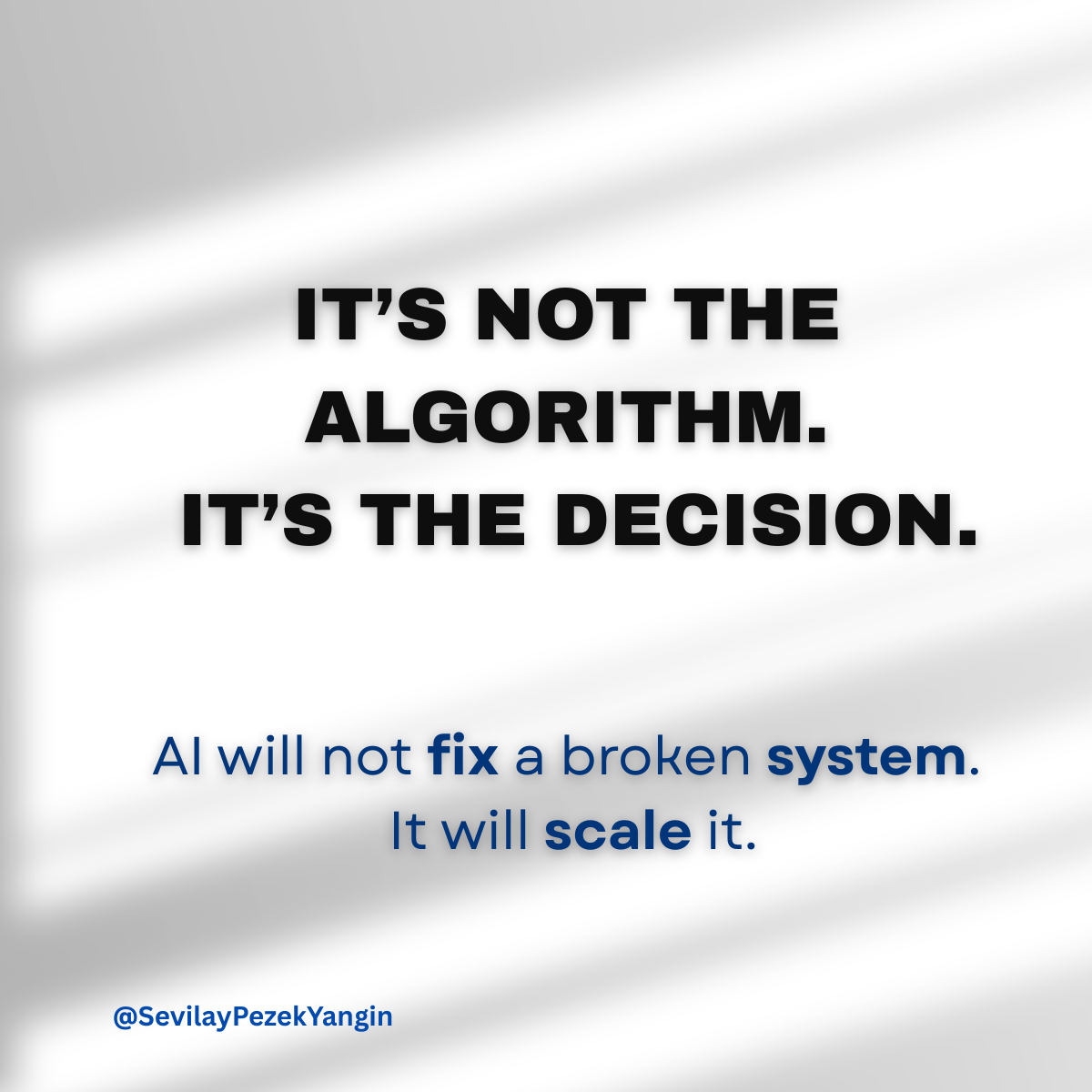
The problem is often not the algorithm.
It is the decision.
And the human system behind it.
I wrote about this in January, and I keep coming back to the same conclusion: we are trying to manage a new world with old architecture.
Across organizations, intelligence is increasing. Tools are improving. Access is expanding. Yet scaled value still stalls.
The gap is not only technological. It is organizational. Intelligence may be available, yet still fail to move into real work, judgment, and execution.
In this context, access is not only about whether tools exist. It is about whether people can use intelligence safely, clearly, and accountably inside the system.
In many cases, the barrier is not capability, but configuration.
By configuration, I mean the design of decision rights, escalation paths, incentive alignment, truth flow, and accountable ownership.
You can see this in something as ordinary as hiring. Organizations talk about future-ready talent, yet many still rely on old filters built for an earlier world: rigid CV screening, unexplained career-gap penalties, location bias, narrow profile matching, and automated exclusion rules that quietly remove the very variation that could improve innovation and decision quality.
The challenge is no longer skill alone. It is whether skill, will, judgment, and alignment can actually work together inside the system.
That is why so many AI initiatives create activity without real transformation.
The system can generate insight.
But it cannot always move it.
It cannot translate it into a decision.
It cannot carry it into execution.
It cannot hold the accountability that follows.
And when intelligence stops moving, organizations do not become more intelligent. They often become more fragmented.
This is the part many leaders still underestimate.
AI can amplify not only patterns in data, but also weaknesses in the human system around decisions: unclear decision rights, weak escalation authority, misaligned incentives, hidden bias, political caution, and execution friction disguised as activity.
So the real issue is not simply whether AI can produce a better answer.
It is whether the organization is designed to receive intelligence and turn it into decision and execution.
That is a different question entirely.
It is a question of access.
Can the right person act on what becomes visible?
Can a leader integrate insight without the system rejecting it?
Can a team surface a risk without consequence?
Can a recommendation move through the organization without being diluted by fear, politics, or ambiguity?
If not, then the problem is not missing intelligence.
It is missing the human conditions required for intelligence to move.
This is where many organizations get trapped.
They keep investing in tools even when the deeper failure sits elsewhere.
They add more intelligence to a system that still cannot carry truth, clarity, or accountable choice.
They optimize generation while neglecting governance.
They improve answer quality while decision quality remains weak.
And in the AI era, decision quality matters more than ever.
Because AI can accelerate speed.
But it cannot own judgment.
It cannot carry moral responsibility.
It cannot answer for the consequences.
Only the human can.
That is why the real strategic divide will not be between organizations that bought AI and those that did not.
It will be between organizations that upgraded the human system around AI, and those that layered new intelligence onto old architecture.
This is also why I keep coming back to a simple thesis:
Many organizations do not have a capability problem alone.
They have a configuration problem.
The challenge is no longer to make intelligence available.
The challenge is to make it actionable.
Trustworthy.
Governable.
Usable under pressure and uncertainty.
That means designing for decision clarity, truth flow, incentive coherence, and human accountability, not as side conversations, but as core conditions of performance.
It also means confronting what sits beneath the visible process layer.
Beneath the workflow often sit what I call invisible ropes: the systemic barriers, biases, fears, and unwritten rules that distort how decisions are really made. They are the risk someone sees and cannot safely name, the insight a team has and cannot turn into action, the decision delayed because the system punishes clarity more than confusion.
That is why this conversation should never have been reduced to a technology conversation.
It is a leadership question.
An organizational design question.
A governance question.
A human system question.
And ultimately, a decision question.
This gap between capability and configuration is why I developed Spiral Intelligence OS™: to help organizations diagnose where intelligence gets blocked and redesign the human system so it can move into decision and execution.
Because the question was never only:
Is the algorithm good enough?
The deeper question is:
Can the human system carry what the algorithm reveals?
That is where the future will be decided.
Not at the level of output alone.
At the level of judgment.
Ownership.
Design.
And the courage to build systems that can hold intelligence without collapsing under it.
The question was never the algorithm.
It was always the decision.
And the human system behind it.
Sevilay Pezek Yangın
Architecture over heroism. Built to hold.
Related articles: